BackerGuardian Trust Meter rates URXR One: 93g Spatial Display Glasses as Medium-Low (Score: 62/100). Moderate risk - due diligence recommended
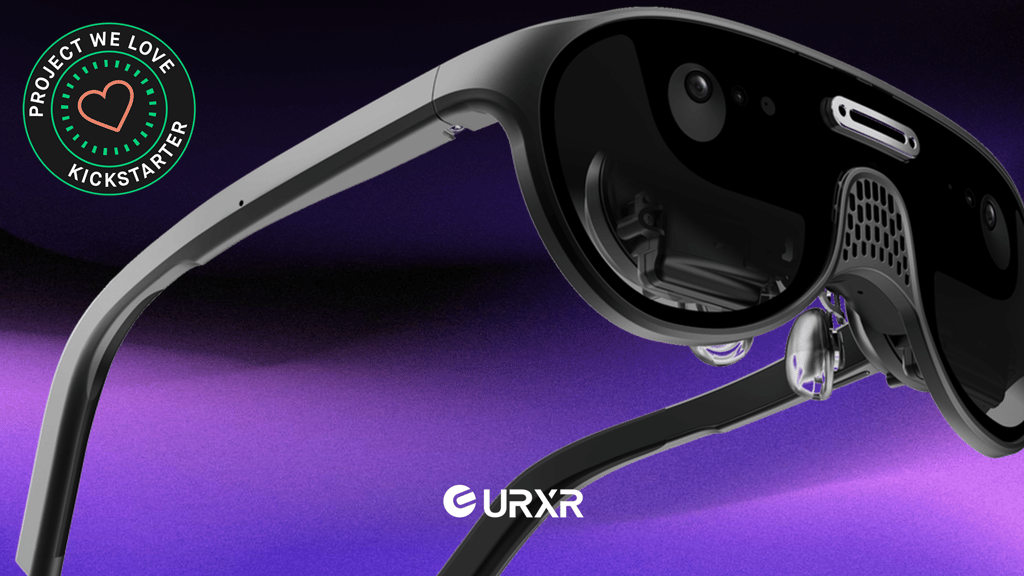
URXR One: 93g Spatial Display Glasses
Forensic Analysis
Trust Meter™ Analysis
Moderate risk - due diligence recommended. Validated by forensic analysis.
Secure redirection to official campaign
Product Analysis
technical_review.mdURXR One Overview
The URXR One is a pair of 93-gram display glasses that carry no computer and no battery. Everything heavy stays on the laptop, phone or handheld you plug them into.
Executive Summary
URXR One is a wearable monitor with spatial tracking built in, not a standalone headset. A single USB-C DisplayPort Alt Mode cable carries both video and power from the host device, which is how Unseen Reality gets the frame down to a claimed 93 grams. Two 1.03-inch micro-OLED panels run 2448 x 2064 per eye at 90 Hz, and an on-glasses 6DoF tracking chip pins a virtual screen to a fixed point in the room so it stays put when you stand up or turn your head. There is a 3DoF mode for moving vehicles, and hand-gesture recognition replaces a controller.
As of our August 5, 2026 capture the campaign had raised $588,766 against a $50,000 goal — about 1,178% — from 765 backers, with a Project We Love badge, in its first 24 hours live. It closes September 18, 2026. Entry is $599 for the Super Early Bird; the $699 Early Bird is already sold out; the standard Kickstarter tier is $799 against a $899 retail price reported at launch. Every tier quotes October 2026 delivery.
Our trust score is 62 / 100 (Medium-Low). The product itself is the strong part: real hardware was demonstrated publicly at AWE USA 2026 more than a month before launch, the architecture deliberately removes the two hardest subsystems, and the risks section names specific, checkable problems instead of boilerplate. The weak part is everything after manufacturing: no factory is named, shipping and duties will not be quoted until after the campaign closes, and a company that has never shipped a crowdfunding reward is promising first units roughly two weeks after it stops collecting money. Verified against the Kickstarter campaign page on August 5, 2026.
Product Specifications
| Spec | Claimed |
|---|---|
| Weight | 93 g |
| Displays | Dual 1.03-inch micro-OLED, 2448 x 2064 per eye |
| Refresh rate | 90 Hz |
| Pixel density | ~36 pixels per degree |
| Field of view | 90 degrees diagonal (~80 H x 56 V per press specs) |
| Tracking | 6DoF dual-camera SLAM, plus a 3DoF mode |
| Cameras | Four forward-facing |
| Motion sensing | Six-axis IMU |
| Audio input | Four-microphone array |
| IPD adjustment | 58–68 mm, manual |
| Connection | USB-C DisplayPort Alt Mode |
| Onboard compute | None — host device supplies picture and power |
| Onboard battery | None |
| Video see-through | Under 10 ms latency, per the company |
| Bypass Mode | 2560 x 1440 at 90 Hz, no app required |
| Connect app | Multi-window, 32:9 aspect, also capped at 90 Hz |
Key Features
- No compute, no battery. The glasses are a display and a sensor package. That is the design decision the whole product rests on, and it is where the 93 grams comes from.
- Bypass Mode needs no software. Plug into any host with a DP Alt Mode USB-C port and it behaves as an ordinary external monitor. If the companion app slips, the hardware still works as a monitor.
- 6DoF room-scale anchoring. The virtual screen holds its position in physical space rather than riding your head, which is the practical difference between this class of device and the 3DoF birdbath glasses it competes with.
- Hand-gesture control. Pinch and drag windows without a controller or a ring.
- Optional Power Hub, $69. A 10,000 mAh pass-through hub with USB-C DP Alt in and out and a 15 W power boost, aimed at phones that cannot power the glasses alone. It has no HDMI input — the creator confirmed in the comments that a PS5 needs a third-party adapter the company will not recommend.
Pledge Tiers
| Tier | Price | Backers | Availability | Delivery |
|---|---|---|---|---|
| Super Early Bird | $599 | 220 | 180 of 400 left | October 2026 |
| Early Bird | $699 | 75 | Sold out | October 2026 |
| Kickstarter Special | $799 | 445 | 1,555 of 2,000 left | October 2026 |
| URXR One Duo Pack | $1,550 | 10 | 490 of 500 left | October 2026 |
Shipping is not included in any tier and is not quoted. The campaign states final shipping costs are calculated and collected closer to fulfillment, with customs, import taxes and fees on the backer. All four tiers ship to restricted destinations only.
Who Is This For?
- People who want a large virtual screen that stays anchored in the room, and who already own a laptop, tablet or handheld with a DP Alt Mode USB-C port to drive it.
- Steam Deck and handheld PC owners, since the host supplies both video and power and no separate box is needed.
- Anyone who has looked at 3DoF display glasses and found the head-locked screen a dealbreaker.
- Backers comfortable paying $599–$799 for a first-generation product from a company with no shipping history, on the understanding that the timeline is the risk.
Who Should Wait?
- Anyone who needs a firm landed cost. Shipping and duties will not be known until after the campaign ends, on a $599–$1,550 pledge.
- Linux users, and iOS users who need extended display: the Connect app has no Linux support today, and the iOS extended-display path depends on Apple API approval the company says it does not control. Bypass Mode works regardless.
- Android users who want multi-window: the creator states the current Android demo needs root access, and the non-root build is the target rather than a shipped feature.
- Console players expecting plug-and-play. HDMI sources need a third-party adapter, and Nintendo Switch needs one the company does not include.
- Anyone who wants an October unit with certainty. First shipments are promised about two weeks after the campaign closes, by a company that has never run a fulfillment cycle.
Forensic Trust Report™
Validating claims with investigative rigor
URXR One Trust Review
Our forensic read of the URXR One campaign, its creator, and the gap between what has been demonstrated and what has been promised. Checked August 5, 2026.
Quick Verdict
62/100 — Medium-Low risk. The unusual thing about this campaign is that the product risk and the delivery risk point in opposite directions. The hardware is real and was handled in public: independent XR channels filmed hands-on segments at the Unseen Reality booth at AWE USA 2026 in late June, more than a month before the campaign opened. The engineering is deliberately conservative for the category — no onboard processor, no battery, a plain USB-C DisplayPort Alt Mode connection, and a Bypass Mode that works as an ordinary monitor with no software at all. The risks section names four specific problems rather than reciting boilerplate.
What has not been demonstrated is the company's ability to ship. Unseen Reality Inc. is a real, named, externally verifiable business in Mountain View with a named CEO and mainstream press coverage, but its Kickstarter account was opened in May 2026, has created this one project, and has backed nothing. No manufacturer is named. Shipping and duties are not quoted and, per the creator, cannot be until after the campaign closes. And every tier prints October 2026 against a September 18 close — roughly two weeks from taking the money to putting units in boxes. Verified against the campaign page on August 5, 2026, day one of the campaign.
Creator Analysis
Score: 60/100. The creator profile shows Joined May 2026, Created 1, Backed 0, no Superbacker badge.
- The company is verifiable. Unseen Reality Inc. operates unseen-reality.com, issued a BusinessWire release on June 26, 2026, and was covered by VentureBeat and Road to VR. It exhibited at AWE USA 2026. This is not an anonymous shell, and it earns the verified identity credit.
- The founder is named and present. Press coverage names founder and CEO Edward Zhou. The same name answers technical questions in the campaign comments under a Collaborator badge. The public identity and the account actually operating the campaign match — a check that has failed on other campaigns in this set.
- There is no delivery record at all. No prior campaign exists under this account or this brand. Kickstarter search for "URXR" and "Unseen Reality" returns only this project. So there is nothing to hold against them, and equally nothing to credit: the 30-point delivered-before bonus is not applied.
- Zero backing history. Backed 0 projects.
We checked specifically for the pattern that caught the PlumCat campaign — a brand that previously ran a campaign under a different creator account, invisible from the current profile. We found no such prior campaign here. That is a negative search result, not a guarantee.
The honest summary: credible company, unproven fulfillment operation. The dimension lands at baseline plus the identity credit.
Trust Dimension Breakdown
| Dimension | Score | What drove it |
|---|---|---|
| Creator Credibility | 60 | Verified company and named CEO; zero delivery history |
| Product Authenticity | 60 | Independent AWE hands-on; no white-label match found |
| Technical Feasibility | 90 | Specific risks section, off-the-shelf architecture; aggressive timeline |
| Supply Chain & Delivery | 20 | No manufacturer named; shipping and duties unquoted |
| Communication Quality | 80 | Creator answers technical questions and concedes limits |
Weights are 0.30 / 0.25 / 0.20 / 0.15 / 0.10, giving 62 / 100.
Three authenticity checks are recorded as not performed rather than passed: whether the campaign video contains raw uncut prototype footage, whether it is CGI-heavy, and whether factory or tooling photography appears in the story body. This run was headless and did not view video or render the story page. Two communication checks are also open — the contents of the 10 FAQ entries were not read, and comment deletion cannot be detected from a single capture. None of these were asserted in either direction.
Technical Feasibility
Score: 90/100 — the strongest dimension, for a structural reason.
The URXR One removes the two subsystems that most often sink crowdfunded headsets. There is no system-on-chip and no battery. The glasses are a display plus a sensor package driven over USB-C DisplayPort Alt Mode, a mature standard, and the micro-OLED panels and IMU are catalog parts at these specifications. Bypass Mode requires no software: if the Connect app slips, backers still receive a working 2560 x 1440 90 Hz monitor. That fallback is worth more than most feature lists.
The risks section is unusually specific and credits the full explanation bonus. It names the EVT-to-mass-production ramp; Apple MFi certification for the Power Hub, disclosing that the hub works uncertified but with limited iOS features; iOS API approval for extended display, with Bypass Mode as the stated fallback; and a Nintendo Switch caveat admitting a third-party adapter is required and not included. Each names a fallback rather than assuming approval.
The deduction is timeline. All four tiers quote October 2026 against a September 18 close, roughly twelve days, which is well inside the three-month threshold. The company's own website says "Fall 2026" and launch press reported mid-October, so the tier dates are the most aggressive figure the company has published. VR.org raised the same point at launch, noting that an early-bird pledge is effectively a bet on a delivery date from a company that has never had to hit one.
We did not trigger the too-good-to-be-true rule. The spec set is aggressive, but 93 grams is a direct consequence of moving compute and battery off the frame, and third parties have handled a working unit. The number to watch is whether production units hold 93 grams, not whether the design is possible.
Supply Chain & Delivery
Score: 20/100 — the dimension that sets this record's ceiling.
- No manufacturer named. The risks section asserts the supply chain is locked but does not identify the factory, and the company website has no manufacturing page. A backer cannot check the claim.
- Shipping and duties are unquoted. The Power Hub add-on states shipping is excluded and final costs will be calculated and collected closer to fulfillment, with customs and import taxes on the backer. Asked directly in the comments for per-destination estimates before the campaign ends, the creator answered on August 5 that duties can only be confirmed after shipping tests with actual units — which happens after the campaign closes. On a $599 to $1,550 pledge, the landed cost is unknown at the moment of commitment.
- No fulfillment partner named. No logistics credit applied.
- What is not a problem: four tiers is the simplest structure in our current set, so no SKU-complexity penalty. Funding is all-or-nothing and the goal was cleared on day one. Tooling photography was not assessed this run.
One open thread: a backer asked on August 5 whether choosing the gunmetal grey vent add-on, a non-standard colour, would push their unit back in the shipping queue. That question was unanswered at capture. On a twelve-day post-close timeline, colour-variant sequencing is exactly the kind of detail that turns into a delay.
Pledge Tiers
| Tier | Price | Backers | Availability | Delivery |
|---|---|---|---|---|
| Super Early Bird | $599 | 220 | 180 of 400 left | October 2026 |
| Early Bird | $699 | 75 | Sold out | October 2026 |
| Kickstarter Special | $799 | 445 | 1,555 of 2,000 left | October 2026 |
| URXR One Duo Pack | $1,550 | 10 | 490 of 500 left | October 2026 |
Reported retail is $899. The $799 standard tier is a $100 discount, and the $599 entry tier a $300 one. Shipping is excluded from all of them. The $69 Power Hub is an add-on, not a tier, and the company site lists it shipping in October 2026 alongside the glasses.
Red Flags Scan
- Marketplace prior-art: nothing found. Searches for the URXR One spec combination returned no AliExpress, Alibaba or Temu listing of the same device under any brand. This was a search-level check, not an exhaustive supplier-catalog audit, and the absence of a named manufacturer means we cannot rule out a contract-manufactured design sold to others later.
- Renders-only: cleared. Independent channels including VRGameDude and AMXRA filmed hands-on segments at AWE USA 2026. VR.org separately reports third parties filmed the device tethered to a laptop at the show. A physical working unit exists.
- Press coverage is thinner than it looks. Road to VR and VR.org are both press-release-based; neither writer wore the device. The independent hands-on that does exist is trade-show depth on the company's own demo hardware, not a review of a production sample. No one has tested a retail unit, because none exists.
- Funding velocity is extreme but explained. $588,766 from 765 backers in the first 24 hours follows a two-month pre-launch campaign: an AWE debut, a BusinessWire release, and a wave of coverage between June 26 and August 1. The velocity reflects prepared demand, not an anomaly.
- Feature claims are being walked back in the comments, honestly. Within a day the creator confirmed there is no Dolby Vision, no Linux support in the Connect app, no HDMI input on the Power Hub, and that the Android multi-window demo currently requires root access. These are corrections against the marketing, volunteered rather than extracted. We read that as a communication strength and a specification caution at the same time.
- Zero updates posted. The campaign is one day old, so this is not yet a signal. Nothing to assess.
Recommendation
Back it if the timeline slipping is acceptable to you. This is not a campaign where the central question is whether the product exists — it does, and people outside the company have worn it. The central question is whether a company with no fulfillment history can go from campaign close on September 18 to units shipped in October, without a named factory, while shipping and customs costs are still unresolved. Our honest read is that the October date is optimistic and the product is sound.
Wait if you need a fixed landed cost, if you are on Linux, if you need the iOS extended-display path rather than Bypass Mode, or if you want to see a production unit reviewed before committing $599 or more. Waiting costs $100 against the $799 standard tier and $300 against the sold-out early tiers — a real premium, but a smaller one than most campaigns charge for patience.
Communication quality is the reason this record scores where it does rather than lower. A creator who says "no Dolby Vision" and "root access required today" on day one is a creator likely to tell backers when the schedule moves. That is not the same as hitting the schedule.
Affiliate disclosure: this record scores at or above our 60-point threshold, which makes it eligible for affiliate linking under our published policy. No affiliate relationship exists with Unseen Reality at the time of writing, and the score was computed from the evidence ledger before any monetization question was considered.
Independent Reviews
Related Investigations
More forensic analysis from our intelligence desk