BackerGuardian Trust Meter rates Cladist Titan: 15+1 Torque Precision Screwdriver as Medium-Low (Score: 65/100). Moderate risk - due diligence recommended
Cladist Titan: 15+1 Torque Precision Screwdriver
Forensic Analysis
Trust Meter™ Analysis
Moderate risk - due diligence recommended. Validated by forensic analysis.
Secure redirection to official campaign
Product Analysis
technical_review.mdExecutive Summary
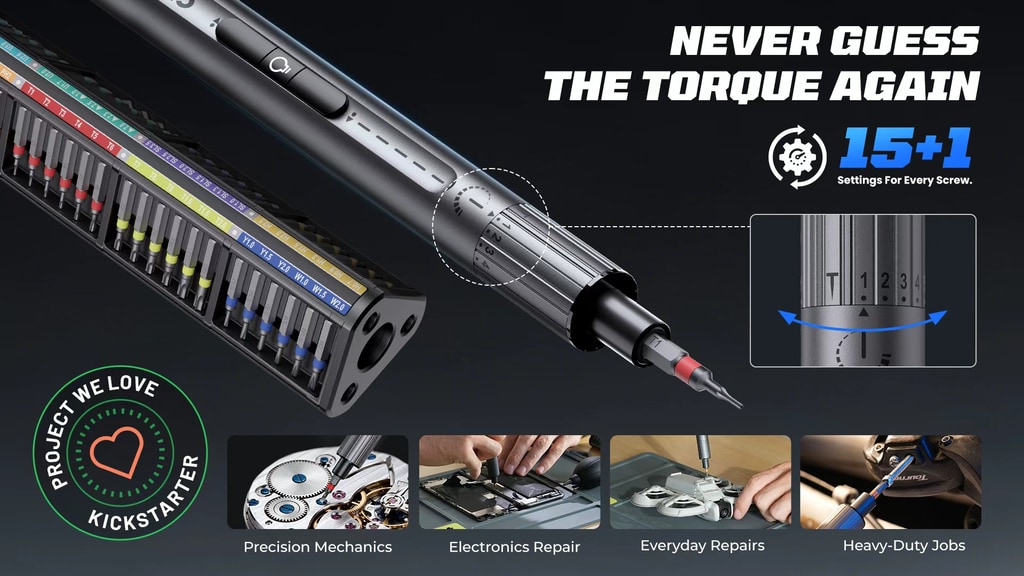
The Cladist Titan is a pocket-size electric precision screwdriver whose pitch is torque control rather than power. Where a typical precision driver gives you one or two clutch settings, the Titan claims fifteen plus a manual mode, spanning 0.05 to 0.8 N·m through an adjustable electronic clutch, paired with a low-runout chuck, four LEDs around the bit, and a 48-piece S2 steel bit set in an aluminium pop-up case. It drives under power or turns by hand through the same body.
The campaign closed on August 13, 2026 having raised $530,639 against a $2,000 goal — about 26,532% funded — from 5,867 backers, carrying a Kickstarter "Project We Love" badge. Our earlier August 6 capture, seven days out, had it at $361,771 from 4,028 backers. Entry was $69 on the early-bird Titan; the Ultimate Kit was $109 and a two-pack $128. All five super-early-bird tiers sold out during the campaign.
Our overall trust score is 65 / 100 (Medium-Low). The reason it sits above most first-time hardware campaigns is a verified delivery record: the same Kickstarter account ran a glove campaign in late 2025 that shipped, and backers say so in that campaign's own comment thread. The reasons it does not sit higher are that nobody outside the company has tested the tool, and no manufacturer is named.
Product Specifications
| Specification | Claimed value |
|---|---|
| Torque levels | 15 electronic + 1 manual mode |
| Torque range | 0.05–0.8 N·m |
| Clutch | Adjustable electronic |
| Chuck | Low-runout |
| Battery | 500 mAh, 3.7 V nominal, 10C rate |
| Charging | USB-C, 5 V / 1 A |
| Battery life | 700–1,000 screws per charge (creator figure) |
| Cycle life | >80% capacity after ~500 cycles (creator figure) |
| Bits | 48-piece S2 steel, magnetic |
| Lighting | 4 LEDs |
| Storage | Aluminium pop-up case, magnetic bit retention |
The battery figures come from the creator's own reply in the campaign comments on August 6, 2026, not from the campaign page — worth knowing, because they are more specific than what the marketing copy states.
Key Features
- Sixteen torque steps instead of two. This is the whole product thesis. Commodity 48-bit precision drivers ship with a single fixed torque figure or a two-position switch; the Titan claims a dialled range from 0.05 N·m (eyeglass hinge) to 0.8 N·m (PC case screw).
- Dual electric and manual operation. The same body drives under power and turns by hand, which matters for the final quarter-turn where a powered driver is most likely to strip a head.
- Low-runout chuck. Keeps the bit centred under load — the mechanical claim that pairs with the torque claim, and the one the creator's own risks section flags as hardest to hold at scale.
- 48-piece S2 steel bit set. Magnetic retention, aluminium pop-up case. This is the part of the package that is most clearly a standard configuration.
- Four-LED ring. Lights the work without the single hard shadow a one-LED driver casts.
Pledge Tiers
| Tier | Price | Backers | Limit | Remaining | Est. delivery |
|---|---|---|---|---|---|
| Cladist Titan — Super Early Bird | $59 | 430 | — | Sold out | Sept 2026 |
| Cladist Titan — Early Bird | $69 | 1,697 | 1,900 | 203 | Sept 2026 |
| Creator Kit — Super Early Bird | $79 | 14 | — | Sold out | Sept 2026 |
| Creator Kit — Early Bird | $89 | 47 | 150 | 103 | Sept 2026 |
| Repair Kit — Super Early Bird | $89 | 73 | — | Sold out | Sept 2026 |
| Repair Kit — Early Bird | $99 | 399 | 500 | 101 | Sept 2026 |
| Ultimate Kit — Super Early Bird | $99 | 289 | — | Sold out | Sept 2026 |
| Ultimate Kit — Early Bird | $109 | 815 | 1,000 | 185 | Sept 2026 |
| Duo Pack — Super Early Bird | $118 | 32 | — | Sold out | Sept 2026 |
| Duo Pack — Early Bird | $128 | 208 | 270 | 62 | Sept 2026 |
Ten tiers, but only five distinct products — each appears once as a sold-out super-early-bird and once as a live early bird. There are no colour or engraving options, so the SKU count is simpler than the tier count suggests.
Who Is This For?
Someone who already owns a precision screwdriver and has stripped something with it. The Titan's argument is specifically about not over-torquing a laptop standoff, an eyeglass hinge, or a camera body screw, and that argument only lands if you have felt the failure it prevents.
It also suits the repair-adjacent buyer who wants one tool across a range: the same driver at 0.05 N·m for glasses and 0.8 N·m for a PC case, with a bit set broad enough that you are not hunting for an adapter. At $69 for the base early bird, it is priced against the commodity 48-bit sets rather than above them, which is the strongest practical case for backing it.
The creator's delivery record supports a September 2026 estimate more than most campaigns can. The gloves shipped, and backers confirm it unprompted.
Who Should Wait?
Anyone buying on the torque numbers specifically. Sixteen calibrated steps is the entire reason to choose this over a $40 VEVOR or HOTO set, and no independent party has put a gauge on it. For a campaign that has taken $361,771 from 4,028 backers, that absence is conspicuous — torque accuracy is measurable, and nobody outside the company has measured it.
Wait also if you need a general-purpose household driver. Two separate backers asked in the comments whether a tool marketed on ultrafine electronics work handles ordinary jobs around the house; the creator engaged the question directly, but the answer is qualitative, and 0.8 N·m is well below what a conventional cordless driver delivers.
Finally, note the shipping pattern from the prior campaign. Delivery happened, roughly four to six months after close — but the recurring complaint in that thread was opacity, not lateness: a tracking number with no courier attached, and shipping emails backers could not find. No fulfilment partner is named this time either.
Forensic Trust Report™
Validating claims with investigative rigor
Quick Verdict
65 / 100 — Medium-Low risk. This is the rare hardware campaign where the creator question is settled and the product question is not.
Cladist has done this before and finished it. The same Kickstarter account ran CLADIST: The Ultimate Cut, Needle & Puncture-Proof Gloves, which closed December 19, 2025 with 860 backers and $80,588, and that campaign's comment thread contains backers describing the product in use months later — not creator claims of shipment, but customers saying "I got mine recently, they fit great" and "I love mine, have been using them every weekend in the garden." That is the strongest form of delivery evidence we can collect without a purchase, and it lifts Creator Credibility to 80.
What holds the score down is that the Titan's central claim is untested by anyone outside the company. Sixteen electronically clutched torque steps from 0.05 to 0.8 N·m is the reason to buy this instead of a commodity 48-bit set, and torque accuracy is exactly the sort of claim a reviewer with a gauge would settle in an afternoon. Nobody had as of our August 6, 2026 evidence pass, and the campaign has since closed funded on August 13, 2026 with that question still open.
Creator Analysis
The profile reads Created 2, Backed 1, joined October 2025 — thin on its face, but the two created projects are the delivered gloves campaign and this one, which is a materially different shape from the Created-1 / Backed-0 accounts behind most campaigns we score.
The delivery evidence is worth stating precisely, because it is the load-bearing fact in this record. The gloves campaign closed December 19, 2025. Backers report receiving units from roughly April 2026 onward — about four to six months after close. That is late against a typical estimate but nowhere near the one-year threshold that triggers a deduction, and the creator answered every waiting backer in the visible thread.
The friction in that thread is instructive and carries forward. Two backers, Michael Street and Greg Drake, were still chasing shipping details around three months ago. One had a tracking number with no courier attached to it, and shipping emails he could not locate in any inbox. The creator responded each time and moved the conversation to Kickstarter messages. The pattern is not neglect — it is poor logistics transparency, and nothing in the current campaign suggests it has been fixed.
External verification is partial. The brand runs its own retail storefront, linked from the prior campaign page, and has product in customers' hands — corroboration a paper brand cannot manufacture. But no company registration was located, and no founder or officer is named publicly. A trading history is not the same as a verified identity, so the identity bonus is not applied.
Trust Dimension Breakdown
| Dimension | Score | Weight | What drives it |
|---|---|---|---|
| Creator Credibility | 80 | 0.30 | Prior campaign delivered, confirmed by backers in that thread |
| Product Authenticity | 50 | 0.25 | No independent hands-on; commodity-class hardware |
| Technical Feasibility | 70 | 0.20 | Off-the-shelf subsystems, offset by a 19-day delivery gap |
| Supply Chain Risk | 40 | 0.15 | No manufacturer named, no fulfilment partner named |
| Communication Quality | 80 | 0.10 | Creator answers within hours, with real specifications |
Several checks are recorded as not performed rather than passed, and the distinction matters. This was a headless collection run: the campaign video was not viewed, the story body was not rendered, and the FAQ contents were not read. So render-versus-photo authenticity, CGI assessment, factory and tooling photography, the shipping-rate table, and FAQ coverage of refunds and warranty are all open questions, not cleared ones. None of them were scored in either direction.
Technical Feasibility
The engineering risk here is genuinely low, and the reason is that almost nothing in the tool is novel. A small DC motor, a 500 mAh 3.7 V lithium cell, USB-C charging at 5 V / 1 A, S2 steel bits and LED ring lighting are all catalogue parts shipping in competing products today. There is no custom silicon, no radio, no firmware platform to bring up. That earns the off-the-shelf-components bonus.
The one genuinely engineered element is the electronic clutch calibration — and to the creator's credit, that is exactly what the risks section flags. It names the correct central problem: holding calibrated torque output and low runout consistently across every unit at scale. That is more than boilerplate.
The mitigation, however, stops at generic language — "careful assembly, testing, and quality control," "every production batch will undergo inspection." No test protocol, tolerance band, sampling rate or standard is named, so a backer has nothing to check the promise against. The challenges-explained bonus is not applied.
On the specs themselves: 0.05–0.8 N·m in sixteen clutched steps is well inside what a small clutched DC drive can do, and 700–1,000 screws from 500 mAh is plausible at that torque. Nothing here is too good to be true. The open question is not whether the design is possible but how close each of the sixteen steps lands to its stated value, and whether that holds across a production run.
The timeline is the deduction. All ten tiers quote September 2026 against an August 13 close — roughly nineteen days from funding to first shipment. The mitigating context is real: mature product class, one fulfilment cycle already completed. But nineteen days leaves no slack whatsoever for a failed QC batch.
Supply Chain & Delivery
This is the weakest dimension at 40, and it is weak for one specific reason: no manufacturer is named anywhere. The risks section refers to "manufacturing and final assembly" and to quality-control procedures the company says it established, without identifying who builds the tool or where.
That omission compounds a second one. Our marketplace check could not rule out that the housing and bit set are a shared ODM platform with a Cladist-specified clutch — naming the factory would have settled both questions at once.
No fulfilment or logistics partner is named either. The risks section acknowledges international fulfilment and customs as a challenge without saying who handles it, which is the same gap that produced the shipping-opacity complaints on the gloves campaign.
Structurally the campaign is sound: all-or-nothing funding, goal met roughly 180 times over, and only five distinct products behind the ten tiers with no per-unit customisation. SKU complexity is not a risk here.
Pledge Tiers
Entry is $69 for the early-bird Titan, with 203 of 1,900 remaining at capture. The Ultimate Kit at $109 is the second-heaviest tier by backer count (815), and the Repair Kit at $99 has taken 399. A two-pack runs $128.
All five super-early-bird tiers are sold out, which accounts for 838 of the 4,028 backers. Every tier quotes September 2026 delivery and ships unrestricted.
One caveat on long-term ownership: asked about replacement bits — a fair question for a 48-piece set — the creator's answer was that replacements are "planned" for the future, with no price and no date. The battery answer, by contrast, was fully specified.
Red Flags Scan
No independent testing. The single most important gap. Search surfaces only the campaign itself, a BackerKit funding tracker, aggregators reposting campaign copy (First Backer, BackerBuzz), and paid social promotion. For $361,771 from 4,028 backers, no third party has published testing of the torque claims.
Commodity category, differentiated spec. 48-bit S2-steel precision drivers with magnetic storage, LED lighting and USB-C charging are a commodity class — VEVOR and HOTO both ship one, and generic 50-in-1 and 62-in-1 sets are on eBay and Amazon now. What separates the Titan is real on paper: those sets run one or two fixed settings (a typical 62-in-1 is fixed at 0.25–0.35 N·m) against sixteen clutched steps here. No pre-launch marketplace listing of this specific device was found under any brand, so the arbitrage kill switch does not fire and no rebadge deduction is applied. But this was a search-level check, not a supplier-catalogue audit.
Nineteen days from close to shipping. Aggressive even for a mature product.
No manufacturer, no fulfilment partner. Both unnamed.
Shipping opacity precedent. The prior campaign delivered, but with tracking numbers lacking courier information and shipping emails backers could not find.
No kill switches fired. No arbitrage listing, no identity fraud indicators, no bad-actor linkage, no physics-violating claims.
Recommendation
Back it if you want the tool at $69 and would be satisfied with a competent 48-bit precision driver even if the sixteen torque steps turn out to be approximate. On that basis the risk is genuinely low: the category is mature, the components are catalogue parts, and this creator has shipped a physical product to 860 backers who say so themselves.
Think harder if you are paying specifically for calibrated torque. That claim is unverified by anyone independent, it is the entire premium over a commodity set, and it is measurable — which makes its absence from the public record more notable than it would be for a subjective claim.
The campaign closed funded on August 13, 2026 at $530,639 from 5,867 backers. The two things we said to watch were whether Cladist would name a manufacturer and whether any reviewer would publish actual torque measurements; as of our last evidence pass neither had happened, and either would still move this score. From here the open question is delivery. We re-check funding and campaign state on our normal maintenance pass, and will revise this record if the facts change.
Checks recorded as not performed on this run — campaign video, story body imagery, FAQ contents, and the shipping-rate table — remain open. They were not scored as passes.
Independent Reviews
Related Investigations
More forensic analysis from our intelligence desk