BackerGuardian Trust Meter rates Kode Dot: The All-In-One Device for Makers, Hackers & Geeks as Medium-Low (Score: 74/100). Moderate risk - due diligence recommended
Kode Dot: The All-In-One Device for Makers, Hackers & Geeks
Forensic Analysis
Trust Meter™ Analysis
Moderate risk - due diligence recommended. Validated by forensic analysis.
Secure redirection to official campaign
Product Analysis
technical_review.mdKode Dot: The All-In-One Device for Makers, Hackers & Geeks
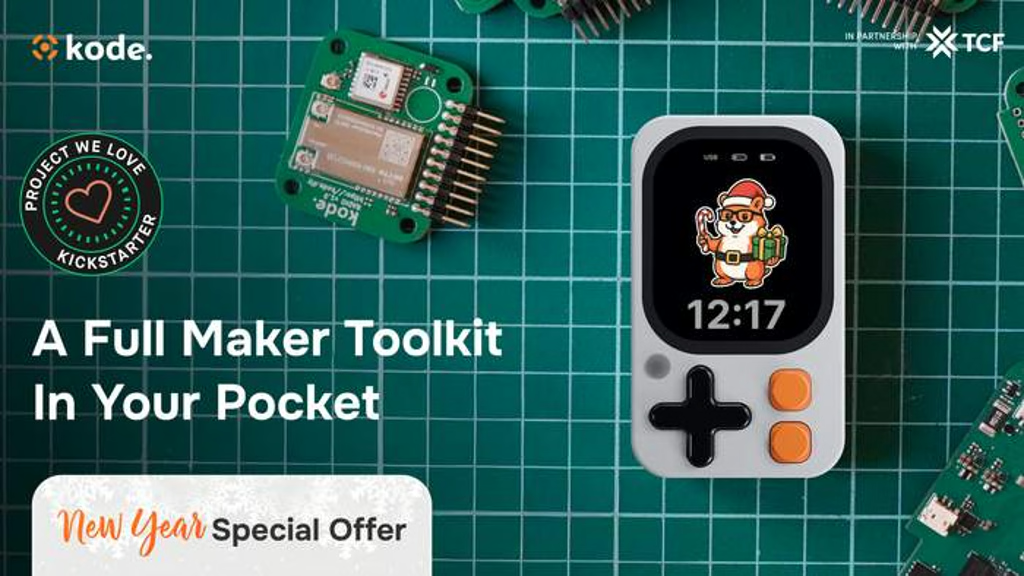
As of July 27, 2026, Kode Dot holds a BackerGuardian trust score of 74/100 (Medium-Low). It is a pocket-sized (73 × 43 × 15 mm, ~50 g) battery-powered ESP32 development device with a color AMOLED touchscreen, made by first-time Kickstarter creator Kode (KODE DIY SL) of Valencia, Spain. The campaign raised $1,751,547 from 8,646 backers against a $5,000 goal between November 4 and December 23, 2025 (Kicktraq), with a July 2026 delivery estimate that is expiring now — creator-side signals show a shipping phase underway, but no backer deliveries were publicly confirmable at the time of this revision. Full analysis, sources, and delivery tracking are in the trust review.
What It Is
A "breadboard replacement": a self-contained microcontroller lab with screen, battery, sensors, and radios, running an app-based OS (kodeOS) so projects can be loaded and switched without re-flashing. Firmware, examples, and drivers are published open source under Apache-2.0/GPL-3.0 on GitHub.
Specifications
The spec changed materially between launch and today. Both columns are sourced; treat the current product page as the authority on what ships.
| Spec | Campaign launch (Nov 2025) | Current product page (Jul 2026) |
|---|---|---|
| Processor | ESP32-S3 dual-core (CNX Software) | ESP32-P4 with ESP32-C5 wireless co-processor (kode.diy) |
| Wi-Fi | 2.4 GHz | Dual-band 2.4 + 5 GHz |
| Other radios | Bluetooth 5 LE | BLE 5, Thread, Zigbee, NFC 13.56 MHz, RFID 125 kHz, IR TX/RX |
| Display | 2.13" color AMOLED, 502×410, touch | 2.13" AMOLED touch + directional pad, two buttons |
| Memory | 32 MB flash, 8 MB PSRAM, microSD | microSD retained (memory not restated on store page) |
| Battery | 500 mAh Li-Po, USB-C | Li-Po, USB-C with OTG |
| Expansion | 20-pin header (12× GPIO, I2C, SPI, UART), magnetic connector | 20-pin header, rear magnetic connector |
| Extras | Mic, speaker, 9-axis IMU | Mic, speaker, 9-axis IMU, haptic motor, RGB LED |
Note: the enclosure was also redesigned after the campaign — the brand site labels campaign-video footage "OLD DESIGN" and states that version will not be sold or received by any buyer (kode.diy).
Price and Availability
| Item | Price | Delivery |
|---|---|---|
| Kickstarter base pledge (closed) | $129 + $15–40 shipping | Estimated July 2026 |
| Transparent edition (closed) | ~$132 | Estimated July 2026 |
| LoRa module bundle (closed) | $149 | Estimated July 2026 |
| Store "Standard Backer Edition" (open) | $199 | Next batch, January 2027 |
Campaign pricing per CNX Software and New Atlas; current pricing per kode.diy, read 2026-07-27.
Who Is This For
- Makers and embedded developers comfortable with Arduino/C++ — reviewers note full use requires coding (513.toys)
- IoT and home-automation tinkerers who want Thread/Zigbee/NFC/IR in one pocket device
- Buyers who specifically value published open-source firmware
Who Should Wait
- Anyone expecting a turnkey Flipper Zero substitute — Sub-GHz radio requires a separately purchased module
- Anyone who needs hardware on a firm date: new orders quote January 2027, and backer deliveries were not yet publicly confirmed as of July 27, 2026
- Non-programmers expecting a consumer gadget
Last verified 2026-07-27. Scores come from the BackerGuardian Trust Meter and change only through the scoring machinery. This page carries no affiliate links.
Forensic Trust Report™
Validating claims with investigative rigor
Quick Verdict
As of July 27, 2026, Kode Dot scores 74/100 (Medium-Low) on our Trust Meter v2.0: a first-time hardware team that raised $1,751,547 from 8,646 backers against a $5,000 goal, closed December 23, 2025, and is now at the very end of its July 2026 delivery window with shipping activity reported by the creator but no backer deliveries we could publicly confirm.
Two corrections up front. An earlier version of this page quoted a score one point higher in its summary capsule than the 74 the scoring machinery actually assigns — the score is 74. It also carried a filler price-comparison table whose competitor rows held no real data; that table has been replaced with sourced pricing only.
Trust Dimension Breakdown
Scores below come from our scoring machinery (Trust Meter v2.0, last computed 2026-07-21). Prose on this page defers to these numbers; they change only through the scoring machinery.
| Dimension | Score | Weight | Rating |
|---|---|---|---|
| Creator Credibility | 65 | 30% | New but Well-Funded |
| Product Authenticity | 85 | 25% | Genuine Innovation |
| Technical Feasibility | 75 | 20% | Ambitious but Achievable |
| Supply Chain & Compliance | 65 | 15% | Moderate |
| Communication Quality | 80 | 10% | Good |
| Overall | 74 | — | Medium-Low |
The shape of the 74: the product is original engineering (85) with real but manageable technical ambition (75). What holds the score down is the classic first-campaign profile — no prior delivery record (65) — combined with the supply-chain reality of building 8,600+ units of a stretch-goal-expanded BOM on a first manufacturing run (65).
Funding Record
Kickstarter blocks our fetcher (HTTP 403 as of 2026-07-27), so campaign figures below are verified against Kicktraq's archive of the campaign.
| Fact | Value | Source |
|---|---|---|
| Launched | November 4, 2025 | Kicktraq |
| Closed | December 23, 2025 (49 days) | Kicktraq |
| Goal | $5,000 | Kicktraq |
| Final | $1,751,547 from 8,646 backers (~35,031% funded) | Kicktraq |
| Creator | Kode (KODE DIY SL), Valencia, Spain | Kicktraq; kode.diy |
| Badges | Kickstarter "Project We Love" | Kicktraq |
The 35,031% figure is against a $5,000 marketing-floor goal, not a production budget — the meaningful number is the $1.75M absolute raise, which is a genuine capital buffer and simultaneously an 8,646-unit fulfillment obligation. Note the campaign launched as "Kode Dot: The All-in-One Pocket Size Maker Device" (the title Kicktraq archived, matching the URL slug) and the Kickstarter listing now reads "The All-In-One Device for Makers, Hackers & Geeks" — the project went through a formal rebranding phase post-campaign (it appears as a workstream on the creator's public timeline).
What the Product Claims
Per campaign-window press (CNX Software, 2025-11-11; New Atlas, 2025-12-12; 513.toys, 2025-12-14): a 73 × 43 × 15 mm, ~50 g pocket "maker device" — a battery-powered ESP32 dev platform with a 2.13-inch 502×410 color AMOLED touchscreen, 500 mAh Li-Po battery, 32 MB flash / 8 MB PSRAM, microSD slot, 9-axis IMU, mic and speaker, NFC/RFID and IR (added as stretch goals), a 20-pin expansion header (12× GPIO, I2C, SPI, UART) plus a magnetic module connector, running an app-based "kodeOS" so projects load without re-flashing.
The spec has churned — worth understanding before treating any single spec sheet as final:
- At launch the device was built on the ESP32-S3 (2.4 GHz Wi-Fi only), as covered by CNX Software.
- A funded stretch goal upgraded it to a dual-architecture processor (Kicktraq lists the unlock); campaign-era communications described an ESP32-P4 + ESP32-C6 pairing.
- The current product page lists "ESP32-P4 with ESP32-C5 wireless co-processor" with dual-band 2.4/5 GHz Wi-Fi, BLE 5, Thread and Zigbee (kode.diy/products/kode-dot, read 2026-07-27) — the C5, not the C6, is the chip that actually does 5 GHz Wi-Fi.
- The official docs still describe "the ESP32-S3, the microcontroller of your Kode Dot" as of 2026-07-27 — documentation lagging the shipped architecture.
Separately, the brand's homepage now labels the Kickstarter campaign videos "OLD DESIGN," stating the prototype design shown there "is not going to be sold nor received by any buyer" (kode.diy). Backers are receiving a post-campaign redesign, not the unit they saw in the pitch video.
One claim that does check out well: the open-source posture. The kodediy GitHub organization publishes firmware examples, drivers, and docs under Apache-2.0 and GPL-3.0 licenses, with repository activity through at least April–May 2026 (examples updated Apr 15, 2026; docs updated May 13, 2026, per the org page as read 2026-07-27). Hardware design files were not among the visible public repos.
Evidence Timeline
- 2025-11-04 — Campaign launches; 49-day window (Kicktraq).
- 2025-11-11 — CNX Software covers the launch spec: ESP32-S3, $129 base pledge, $149 LoRa bundle, shipping $15–40, delivery July 2026.
- 2025-12-12 — New Atlas: over $640,000 from 3,200+ backers at that point; $129 pledge against a claimed $169 retail; July 2026 worldwide shipping. Hackster.io also covers it in the same frame ("Kode Dot Wants to Dethrone the Flipper Zero").
- 2025-12-14 — 513.toys publishes a spec-based review (no stated hands-on unit): over $806,000 raised; mass production scheduled March 2026, shipping July 2026; flags the wait and that Sub-GHz radio requires a separately purchased module.
- 2025-12-17 → 2026-01-12 — Community thread at Dangerous Things forum: at least one member backs it; in January members question a LinkedIn posting for an embedded systems lead engineer ("To me it's suspicious they didn't already have one"), with a counterpoint that hiring supports the stretch-goal chip integration.
- 2025-12-23 — Campaign closes: $1,751,547 from 8,646 backers; stretch goals unlocked include built-in IR, NFC/RFID, vibration motor, and the dual-architecture processor upgrade (Kicktraq).
- 2026-04-24 → 2026-05-27 — The creator's public timeline logs three entries in its Shipping phase (Apr 24, May 6, May 27); page last updated May 27, 2026. The entries carry dates but no readable descriptions, so what exactly shipped, and to whom, is not stated.
- 2026-04/05 — Open-source activity continues on GitHub (examples Apr 15; docs May 13, per the org page).
- 2026-07-21 — Trust score last computed by our scoring machinery: 74/100, Medium-Low.
- 2026-07-27 — Record re-verified against current sources (this revision). Kickstarter page returns 403 to our fetcher; brand store is selling a "next batch · January 2027" at $199.
Delivery Status
Campaign ended: yes (December 23, 2025). Backer deliveries confirmed: not publicly verifiable as of July 27, 2026.
The campaign's stated estimate was July 2026 (CNX Software; New Atlas) — the window we are in right now. The circumstantial signals point in a mostly positive direction: the creator's own timeline reached its Shipping phase with entries from April 24 through May 27, 2026, and the brand store is selling a next batch for January 2027 delivery, which implies the first production run is spoken for. But we could not find a single public backer receipt report — no forum posts, no press confirmation of delivered units — and the Kickstarter updates feed is not accessible to our checker. Creator-side signals say shipping; independent confirmation is absent.
Delivery-ledger classification: delivery window open — creator reports shipping phase; backer receipt unconfirmed (as of 2026-07-27). If no delivery confirmations surface by end of August 2026, this record should be reclassified as late.
Pricing Reality
| Item | Price | When | Source |
|---|---|---|---|
| Kickstarter base pledge | $129 (+$15–40 shipping) | Campaign (Nov–Dec 2025) | CNX Software, New Atlas |
| Transparent (Collector's) edition | ~$132 | Campaign | New Atlas, 513.toys |
| Kode Dot + LoRa module bundle | $149 | Campaign | CNX Software |
| Claimed retail price during campaign | $169 | Campaign marketing | New Atlas |
| Actual store price today ("Standard Backer Edition") | $199, January 2027 batch | As of 2026-07-27 | kode.diy/products/kode-dot |
Backers got a real discount: the post-campaign retail price landed at $199, higher than the $169 the campaign advertised as retail. Anyone ordering today is paying $199 and joining a queue behind 8,646 backers, with delivery quoted for January 2027. Note also that "Sub-GHz" radio capability — the feature that invites Flipper Zero comparisons — requires a separately purchased module, per 513.toys.
Who This Is For
- Makers, IoT hobbyists, and embedded developers who want a battery-powered, screen-equipped ESP32 platform in a pocket format, and who are comfortable in the Arduino/C++/ESP-IDF world — 513.toys is explicit that full use requires coding knowledge.
- People who value the open-source posture: the firmware, examples, and drivers are actually published under real licenses on GitHub, which is more than most crowdfunded gadgets manage.
- Backers who understand that a first-time hardware team fulfilling 8,646 units may slip, and priced that in at $129.
Who Should Pass
- Anyone buying it as a turnkey Flipper Zero alternative: pentest-adjacent Sub-GHz features need an extra module, and the out-of-box experience leans on your own code.
- Anyone who needs the device on a firm date — the next publicly purchasable batch is quoted January 2027, and even backer deliveries are not yet publicly confirmed.
- Anyone uncomfortable that the shipped design and silicon differ from the campaign pitch (redesigned enclosure; S3 → P4 + C5/C6 co-processor churn; docs still describing the S3).
Red Flags Scan
Kill switches triggered: none, per the scoring machinery. Shell-company indicators: none recorded. Observations from this re-verification, for the record:
- Marketing numbers exceed the Kickstarter record. The store page says "You're joining 16,000 Kickstarter backers" and a homepage thumbnail says "Raised $2M on Kickstarter" (kode.diy); Kickstarter's own campaign closed at 8,646 backers and $1,751,547 (Kicktraq). Late pledges and pre-orders may explain part of the gap, but as stated, both store claims are unverified inflation of the on-platform record.
- Post-campaign redesign. The brand's own site says campaign-video units are "not going to be sold nor received by any buyer." Redesigns can be improvements; they are also unreviewed hardware — every campaign-era hands-on impression covered a unit nobody will receive.
- Spec churn without stable documentation. S3 at launch, P4+C6 announced via stretch goal, P4+C5 on today's spec sheet, while docs.kode.diy still references the S3. None of this is dishonest per se, but it makes "what exactly am I getting" harder to answer than it should be seven months post-campaign.
- Staffing question, community-raised. In January 2026, forum members flagged a LinkedIn posting for an embedded systems lead engineer as odd timing for a funded hardware team (Dangerous Things forum); a fair counterpoint in the same thread is that stretch-goal silicon changes justify hiring. Noted, not weighted.
- No public fulfillment record. Shipping-phase entries on the creator timeline carry no descriptions, the timeline hasn't been updated since May 27, 2026, and we found no independent backer receipt reports. The evidence of shipping is entirely creator-side.
Bottom Line
Kode Dot: 74/100, Medium-Low — a genuinely original, genuinely open-source pocket dev platform whose $1.75M raise bought both a real capital buffer and an 8,646-unit obligation now coming due. The engineering signals (working prototypes shown to press, sustained GitHub activity, honored stretch goals) are better than the median first campaign. The open question is singular and current: it is the last week of the July 2026 delivery window and no backer delivery is publicly confirmed. The creator-side evidence says units are moving; the independent evidence says nothing yet. Watch the next few weeks — confirmed deliveries validate the 74; silence into September starts eroding exactly the dimensions that are already its weakest.
Last verified 2026-07-27. Scores come from the BackerGuardian Trust Meter and change only through the scoring machinery. This page carries no affiliate links.
Related Investigations
More forensic analysis from our intelligence desk