BackerGuardian Trust Meter rates Morpho UV Printer: Industrial-Grade Printing Reimagined as Medium (Score: 51/100). Elevated risk - exercise caution
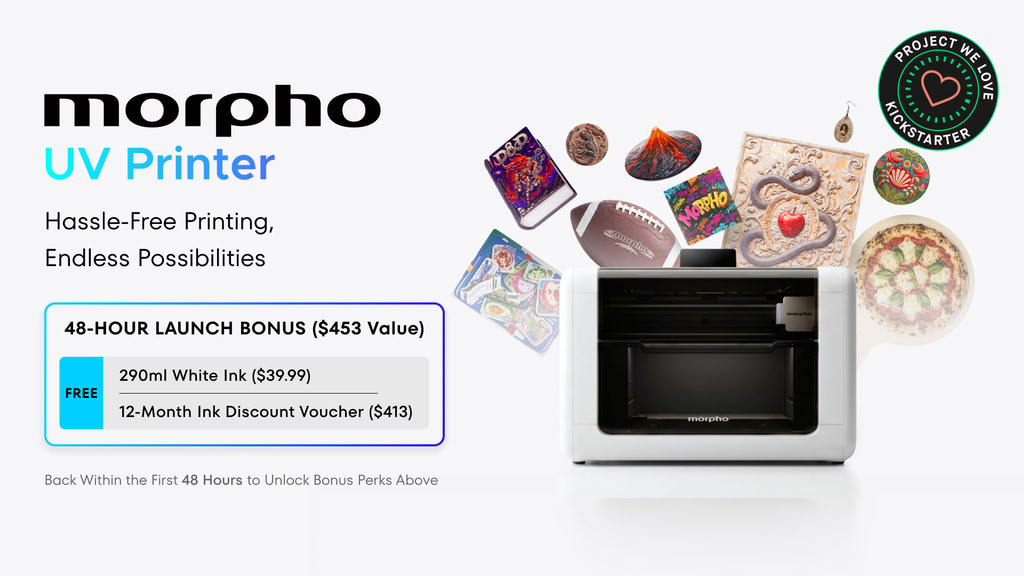
Morpho UV Printer: Industrial-Grade Printing Reimagined
Forensic Analysis
Trust Meter™ Analysis
Elevated risk - exercise caution. Validated by forensic analysis.
Secure redirection to official campaign
Product Analysis
technical_review.mdExecutive Summary
Morpho is a desktop UV printer that decorates objects you already own rather than fabricating new ones: it lays ink — and raised texture — onto phone cases, tumblers, canvas, plaster, signage and similar surfaces, and it targets Etsy sellers and small print shops who currently outsource that work. The campaign launched August 20, 2026 and our August 22, 2026 capture records $8,849,277 pledged against a $50,000 goal — about 17,699% funded — from 2,503 backers, with a Kickstarter staff-pick badge, 207 comments and 4 updates inside the first two days. It closes October 14, 2026, and every tier lists December 2026 delivery.
Two facts shape everything below. The machine is real: an outside reviewer ran a pre-production unit and printed with it. And the account raising $8.8M is one month old with no prior Kickstarter history — the delivery record the campaign points to belongs to a company whose relationship to Morpho no first-party source confirms.
Product Specifications
| Spec | Claimed |
|---|---|
| Resolution | 2400 DPI |
| Colour accuracy | ΔE<1.5 |
| Object height | Up to 60mm |
| Printhead options | F1080 (Standard pack), i3200 (Pro pack) |
| Textures | 1,000+ built-in textures and effects |
| Surfaces | 2,000+ claimed printable surface types |
| Maintenance | NoClog system, claimed 90%+ less maintenance ink |
| Ink | EcoInk refillable, marketed near-zero odour |
| Scanning | 2.5D scanning to build relief texture |
| Estimated delivery | December 2026 |
Every figure in this table is the creator's claim from the campaign page, read August 22, 2026. They are not independently measured numbers — see the review for what the one outside party to run the hardware actually observed.
Key Features
- Prints onto finished objects up to 60mm tall, so the output is a decorated product rather than a printed sheet applied to one.
- Two printhead choices at different price points. Both the F1080 and the i3200 are established Epson printheads already used across desktop and industrial UV printers, not bespoke parts.
- Relief texture from 2.5D scanning, pitched at tactile finishes rather than flat colour.
- Refillable ink and a self-cleaning maintenance cycle, aimed squarely at the running cost that makes small-shop UV printing painful.
Pledge Tiers
| Tier | Price | Backers at capture |
|---|---|---|
| Morpho Standard Pack — Early Bird | $1,799 | 596 |
| Morpho Pro Pack — Early Bird | $2,999 | 1,023 |
| Morpho Pro Workflow Bundle — Early Bird | $3,999 | 474 |
| Morpho Pro Deluxe Bundle — Early Bird | $4,749 | 363 |
| Morpho Pro Twin Bundle — Early Bird | $7,999 | 13 |
Backers are concentrated on the $2,999 Pro pack. The five tiers account for about $7.86M of the $8.85M raised; the remaining ~$986,000 is add-ons purchased on top of tiers. All tiers ship worldwide and all list December 2026.
Who Is This For?
- Etsy and craft-fair sellers who currently pay a third party to print blanks and want that margin and turnaround in-house.
- Small print and signage shops sizing a second machine, where the F1080 versus i3200 choice is a familiar decision rather than a mystery.
- Makers who already own a laser or 3D printer and want colour and texture on the parts those machines produce.
Who Should Wait?
- Anyone who needs the 2400 DPI and ΔE<1.5 numbers to be true at delivery. The only outside party to print on the hardware reported grainy and blurry results on a pre-production unit, with software still in development.
- Buyers who need the machine on a date. December 2026 is seven weeks after the campaign closes, for a product whose firmware was unfinished as of the pre-production review.
- Anyone who cannot comfortably lose the pledge. These are $1,799–$7,999 commitments to a Kickstarter account created in July 2026, and Kickstarter pledges are not purchases.
Forensic Trust Report™
Validating claims with investigative rigor
Quick Verdict
51/100 — Medium risk, checked 2026-08-22. The hardware is real and the company behind it is real: an outside reviewer physically printed with a pre-production unit, and founder Mingyu (Brett) Wang is a traceable figure — former VP of R&D at DJI, product manager on the Phantom 2 Vision, credited on 500+ patents. What holds the score at Medium is a combination this site sees often at very high funding levels: a Kickstarter account created in July 2026 with zero delivery history holding $8.85M, a delivery-record claim that points at a parent company no first-party Morpho source names, no manufacturer disclosed anywhere, and print output that the one outside tester described as grainy and in places blurry. None of that means the machine will not ship. It means the reassurance on the campaign page is currently worth less than the money being committed. Captured two days into a campaign that runs to October 14, 2026.
Creator Analysis
Score: 40/100. The Kickstarter account morpho-inc
joined July 2026 and shows Created 1, Backed 0 — a profile with no history of any kind, which costs 20 points.
- Identity, verified (+10). Morpho Inc. is not anonymous. The founder is named on the company's own About page and in two wire-service press releases (GlobeNewswire, July 2, 2026; PR Newswire, August 21, 2026), and the company carries a Dealroom listing. Mingyu (Brett) Wang's DJI background is specific and checkable.
- The Zuvi claim, checked and not credited. The campaign's risks section states: "Morpho's parent company, Zuvi, has successfully developed, mass-produced, and delivered multiple hardware products to customers around the world." Zuvi is demonstrably a real hardware company — the Halo hair dryer won a TIME Best Inventions listing and an iF Design award and sells through Amazon, QVC and goop. But checked on August 22, 2026, morpho.inc's homepage names only "Morpho Inc." in its copyright, the About page names no parent company and describes no previously delivered product, and neither Morpho press release mentions Zuvi at all. Third-party coverage links the two at founder level — Wang founded both — which is a shared founder, not corporate parentage and not a delivery record belonging to this account. No delivery bonus was awarded.
- No prior campaign means nothing to have abandoned or delivered late; those checks are recorded clear on absence, not on a positive track record.
Trust Dimension Breakdown
| Dimension | Score | Weight | Basis |
|---|---|---|---|
| Creator Credibility | 40 | 30% | Zero-zero account (−20); externally verified identity (+10) |
| Product Authenticity | 40 | 25% | Outside hands-on with physical hardware (+10); output fell short of marketed spec (−20) |
| Technical Feasibility | 70 | 20% | Off-the-shelf Epson printheads (+10); December delivery is tight (−10) |
| Supply Chain Risk | 40 | 15% | No manufacturer or fulfilment partner named anywhere (−20) |
| Communication Quality | 90 | 10% | 42 FAQs (+10); specific, sourced creator replies (+10) |
Every line is computed from the evidence ledger in this record. No dimension carries points without a source URL and a capture date, and four checks that could not be completed this session are recorded as not performed rather than assumed — see Red Flags Scan.
Technical Feasibility
Score: 70/100. The headline specs are demanding but not extraordinary for the class: 2400 DPI, 60mm object height and ΔE<1.5 are all figures existing UV flatbeds reach. Nothing here needs an unexplained breakthrough, so no too-good-to-be-true deduction applies. The design earns a bonus for building on proven parts — the two packs are distinguished by printhead, F1080 and i3200, both long-established Epson heads already common in this market, which is a far lower-risk choice than a bespoke jetting system.
The deduction is the schedule. Every tier lists December 2026, which is 47 days after the October 14 close, and the outside reviewer recorded that "software, settings and some hardware parameters were still being developed" on the unit tested. Finishing firmware, tuning print quality across two printhead variants and shipping several thousand machines inside seven weeks is aggressive.
The risks section earns no bonus. It concedes that manufacturing, supply chain, quality control and logistics problems can happen, then moves to reassurance about the parent company and institutional investors. It names no specific technical challenge and no mitigation.
Supply Chain & Delivery
Score: 40/100. No manufacturer and no fulfilment partner is named — not in the risks section, not on the About page, not in either press release. The campaign asserts "an established supply chain, experienced manufacturing and production teams, and rigorous quality control processes," but attributes them to the parent company whose relationship to Morpho no first-party source states. The About page places headquarters in Shenzhen; the Kickstarter listing shows Wilmington, Delaware.
What is defined: all five tiers ship worldwide with a stated December 2026 month, and five tiers built from two machine variants is modest configuration complexity by Kickstarter hardware standards. Add-ons are being sold on top, accounting for roughly $986,000 beyond tier face value, which adds picking-and-packing variety at fulfilment.
Pledge Tiers
| Tier | Price | Backers at capture |
|---|---|---|
| Standard Pack — Early Bird | $1,799 | 596 |
| Pro Pack — Early Bird | $2,999 | 1,023 |
| Pro Workflow Bundle — Early Bird | $3,999 | 474 |
| Pro Deluxe Bundle — Early Bird | $4,749 | 363 |
| Pro Twin Bundle — Early Bird | $7,999 | 13 |
Average pledge at capture is $3,535 against a tier-weighted average of $3,185 — the gap is add-ons. The money reconciles cleanly against the tier table, so the funding figure shows no anomaly: 2,469 of 2,503 backers sit on a listed tier.
Red Flags Scan
- Marketed spec versus observed output (scored, −20). FauxHammer ran a pre-production unit and reported that "some i3200 prints appeared grainier than expected," some shallow jigsaw-style tests were inconsistent, and "family-photo prints came out blurry," while advising readers to judge on "final print-quality evidence, alignment validation, safety documentation." That review is also disclosed sponsored content, which this site treats as a bias signal in both directions — it is worth noting the negative findings survived the sponsorship.
- $8.8M on a one-month-old account (scored, −20). Not fraud evidence on its own; large pre-launch email lists produce exactly this curve, and this campaign raised over $7M in its first 16 hours by the company's own account. It does mean the account has no reputational history to lose.
- The parent-company framing (scored via no bonus). Detailed under Creator Analysis. Readers should not treat Zuvi's shipping record as this campaign's shipping record.
- Checks not performed this session. Reverse-image and marketplace searches for a white-label equivalent, factory and tooling photography review, fulfilment-partner verification, and comment-deletion monitoring were not carried out and are recorded as not performed. They are not implied clear. On a machine of this class, the white-label check in particular is worth completing before the campaign closes, and this score can move when it is.
Recommendation
Treat this as a considered risk, not a safe pre-order. The product exists, the founder is real and checkable, the printheads are proven parts, and the creator answers backers quickly and specifically — 42 FAQs and same-day replies in the comments two days in is genuinely good communication. Against that: no manufacturer named, a delivery claim that leans on a corporate relationship no first-party source states, a December date that is tight against unfinished software, and the only independent print samples showing quality below what the campaign advertises.
If you back it, back it at a tier you can afford to lose, and watch for three things before the October 14 close: final print samples from a non-sponsored tester, a named manufacturing or fulfilment partner, and a clear first-party statement of the Zuvi relationship. If those arrive, the score moves up. Waiting for the retail release costs you the early-bird discount and very little else.
Facts in this review were captured August 22, 2026, when the campaign was two days old. Funding figures move daily; the snapshot log in this record carries the dated series.
Independent Reviews
Related Investigations
More forensic analysis from our intelligence desk