BackerGuardian Trust Meter rates VENTYRA R1 — Portable Wind Power System for Off-Grid Freedom as Medium (Score: 55/100). Elevated risk - exercise caution
VENTYRA R1 — Portable Wind Power System for Off-Grid Freedom
Forensic Analysis
Trust Meter™ Analysis
Elevated risk - exercise caution. Validated by forensic analysis.
Secure redirection to official campaign
Product Analysis
technical_review.mdExecutive Summary
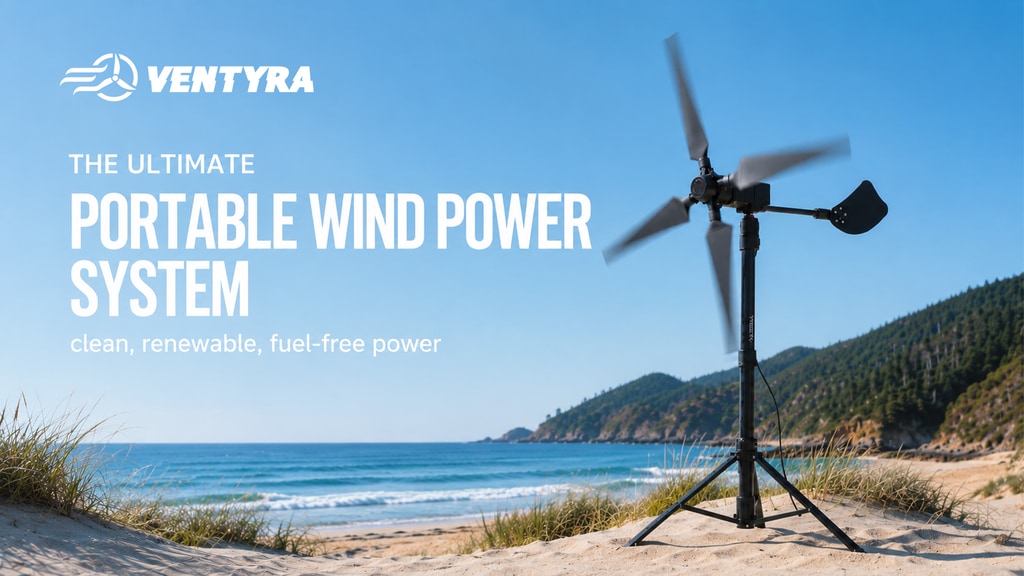
The VENTYRA R1 is a foldable four-blade wind turbine on a collapsible tripod that feeds a small Power Hub with USB-A and USB-C outputs. The whole kit weighs 2.2 lb (1 kg) and packs into a multi-day hiking pack. The pitch is straightforward: solar panels stop working at night and under cloud, wind does not, so a backpacker carrying both has power in conditions where either alone would leave them dark.
The campaign closed successfully on 2026-09-05 at $220,806 against a $1,500 goal — about 14,720% — from 1,032 backers, with no staff-pick badge (captured 2026-09-28; our 2026-08-17 capture, with 19 days left to run, had it at $107,611 from 514 backers). Every tier quotes December 2026 delivery. Entry was $159 on the Launch Day Special and $179 on the Super Early Bird. Pledging has ended — this record now tracks delivery.
The number that needs care is the headline. The campaign sells "50W output, 75W peak load" with no wind speed attached. The graduated figures — reported by both New Atlas and Notebookcheck from the campaign's own materials — are roughly 10 W in light wind, 50 W in strong wind, and 75 W only in gusts, with generation starting at 3 m/s (6.7 mph). Those are physically coherent numbers for a rotor this size. They are also a long way from what the headline implies a camper will actually collect.
Product Specifications
| Field | Detail |
|---|---|
| Turbine | Four-blade foldable rotor on a collapsible tripod |
| Rated output | 50 W stated output, 75 W stated peak load |
| Cut-in wind speed | 3 m/s (about 6.7 mph) |
| Output by conditions | ~10 W light wind, 50 W strong wind, up to 75 W in gusts |
| Kit weight | 2.2 lb (1 kg) including turbine, tripod and Power Hub |
| Connections | XT60 lead into Power Hub; USB-A and USB-C out; 12 V DC support |
| Weather rating | No official IP rating; not built for heavy rain |
| Swept area / rotor diameter | Not published by the campaign or any press coverage |
| Funding | Closed 2026-09-05 at $220,806 from 1,032 backers (14,720%), captured 2026-09-28 |
| Delivery | December 2026 on all seven tiers |
Key Features
Wind as the complement to solar, not the replacement. The strongest version of this product's argument is not that it beats a solar panel — it is that it works on the axis solar cannot: overnight, under heavy cloud, in winter. Two of the seven tiers are explicit wind-plus-solar bundles, which suggests the creator understands this as well.
Genuinely small and light. A 1 kg total kit including the tripod is the specification that makes this interesting to anyone counting grams. Portable wind has been tried before on Kickstarter — KiteX's Wind Catcher is the obvious predecessor — and packability is where these designs usually fail.
A low cut-in speed. Generation beginning at 3 m/s matters more for real-world usefulness than the peak figure does, because 6.7 mph is a breeze you actually encounter at a campsite. It is also the honest half of the specification, and the campaign does publish it.
The unpublished specification. Swept area — rotor diameter — appears nowhere in the campaign or in either press article. That is the one number that would let a reader verify the 50 W claim without trusting anyone, because output scales with swept area and with the cube of wind speed. Its absence is not evidence of a bad product, but it is a conspicuous gap in a listing that leads with a wattage.
Pledge Tiers
| Tier | Price | Backers |
|---|---|---|
| Launch Day Special — VENTYRA R1 | $159 | 100 |
| Super Early Bird — VENTYRA R1 | $179 | 198 |
| Launch Day Special — Wind + Solar Bundle | $189 | 80 |
| Early Bird — VENTYRA R1 | $199 | 8 |
| Super Early Bird — Wind + Solar Bundle | $209 | 93 |
| Launch Day Special — Double Pack | $309 | 20 |
| VENTYRA R1 — Double Pack | $329 | 6 |
All seven tiers quote December 2026 delivery and ship worldwide. Notebookcheck reports an expected retail price around $300, which puts the $159 entry at roughly half.
Who Is This For?
Backpackers, overlanders and van-dwellers who already carry a solar panel and have been caught out by a run of cloudy days or long nights. The R1 is a hedge against solar's failure mode rather than a primary generator, and the bundle tiers price it that way.
People who camp somewhere reliably windy — coastal, exposed ridgelines, open plains — will get closer to the upper figures than anyone pitching a tent in sheltered woodland. Wind resource is intensely local, far more so than sunlight, and that determines whether this is a useful device or a 1 kg ornament.
It also suits anyone who values the 10 W trickle for what it is. Ten watts overnight is a phone and a headlamp topped up by morning, which is a real outcome even if it is not the one on the poster.
Who Should Wait?
Anyone who read "50W" and budgeted around it. Sustained 50 W needs a strong, steady wind — New Atlas puts it plainly, noting that real-world ground wind is turbulent and that steady 50 W output generally needs consistent high-altitude airflow a small ground-level tripod might rarely meet. Treat 10 W as the planning figure and 50 W as the good day.
Anyone who needs to camp in the wet. There is no IP rating, and the creator's own position is that the unit is not built for heavy rain and should be taken down — an awkward requirement for a device whose best weather is often the weather that also brings rain.
Anyone who wants delivery risk priced in. This is a first-time creator: the account joined June 2026, has created one project and backed none, and has no delivery history of any kind. No independent party has tested the hardware — both press articles are written from the campaign page. December 2026 is roughly twelve weeks after close, which is not an aggressive timeline, but a first hardware batch from an unproven team is where crowdfunding schedules usually slip.
Forensic Trust Report™
Validating claims with investigative rigor
Quick Verdict
Checked 2026-08-17: the VENTYRA R1 scores 55 / 100 (Medium) and is not affiliate-eligible under our ≥60 gate. Nothing here looks like a scam. What the record shows instead is an unproven team with a plausible product, a headline number that flatters the typical case, and — unusually for a campaign that has raised $107,611 — not one person outside the company who has put the thing in wind and measured what came out.
The score is held down by creator credibility (40). The account joined June 2026, has created one project and backed none, and has no delivery history in either direction. Two independent outlets, New Atlas and Notebookcheck, have written the product up, which is more external attention than most first campaigns get. Neither tested it. Both say so.
The campaign ran until 2026-09-05, 19 days out from this check, and closed successfully at $220,806 from 1,032 backers (captured 2026-09-28).
Creator Analysis
The account is new and thin, and that is the whole finding. Kickstarter profile 120946309 reads Created 1, Backed 0, joined June 2026. A Kickstarter search for VENTYRA returns this campaign and nothing else — the only other hit is an unrelated Swiss watch brand. There is no prior campaign, so the +30 prior-delivery bonus cannot be earned, and equally there is no abandoned campaign or late delivery on record. Absence of a bad history is not a good history.
Company verification is where this scores an actual deduction (-10). The product has press coverage; the company does not have independent verification. Searches for a VENTYRA wind-power entity in Denver, Colorado turn up no corporate registration, no named founders or engineers, and no company record — only this campaign's press pickup and unrelated Colorado wind firms. New Atlas describes the team as "a group of designers, engineers and outdoor explorers", which is the campaign's own self-description repeated back, not third-party confirmation of who is behind it.
That matters more than usual here. On a product whose central claim needs a test bench to verify, knowing who is making it is part of what a backer is buying.
Trust Dimension Breakdown
| Dimension | Score | Weight | Driver |
|---|---|---|---|
| Creator Credibility | 40 | 0.30 | First campaign, no delivery history, company not independently verifiable |
| Product Authenticity | 50 | 0.25 | Press coverage exists but no hands-on test by anyone |
| Technical Feasibility | 70 | 0.20 | Graduated output figures are physically coherent |
| Supply Chain Risk | 60 | 0.15 | Seven clean tiers; manufacturer and shipping detail unread |
| Communication Quality | 70 | 0.10 | 21 comments, 1 update in 11 days, only 2 FAQ entries |
Product authenticity sits at its baseline 50 rather than earning the +10 third-party-review bonus. Coverage in New Atlas and Notebookcheck is real coverage, but both outlets state they are working from the campaign page and creator responses. Under the precedent we set on minimal-phone-2, spec-sheet news does not count as a third-party review. On a $107,611 raise, zero independent measurement is the single most notable gap in this record.
Technical Feasibility
We assessed the 50 W claim as a candidate too-good-to-be-true finding and did not trigger it. The reasoning is worth showing.
The campaign's graduated figures — about 10 W in light wind, 50 W in strong wind, 75 W in gusts, cut-in at 3 m/s — are internally consistent and physically reasonable for a small rotor. An order-of-magnitude check supports that: at a realistic small-turbine power coefficient near 0.30 and standard air density, 50 W needs roughly 11–13 m/s of sustained wind — 25 to 29 mph — for a rotor in the 0.4–0.5 m diameter range. That is a strong breeze to near gale on the Beaufort scale, which is exactly what "50 W in strong winds" describes.
Two honest caveats. The rotor diameter in that calculation is our assumption, not a published specification — the campaign and both press articles omit swept area entirely, which is the one number that would let any reader check the wattage independently. And output scales with the cube of wind speed, so the gap between a 6.7 mph breeze and a 25 mph blow is not incremental; it is roughly a factor of fifty in available power. That cube law is why the same device honestly produces both 10 W and 50 W.
So the claim is not false. The marketing is what deserves the flag: "50W output, 75W peak load" leads the campaign with no wind speed attached, and the figure a camper will typically see is nearer 10 W. New Atlas reached the same conclusion independently, noting that real-world ground wind is turbulent and steady 50 W generally needs consistent high-altitude airflow a small ground-level camping tripod might rarely encounter.
Delivery timing does not trigger our aggressive-timeline rule. The campaign closed 2026-09-05 and all seven tiers quote December 2026 — roughly twelve to thirteen weeks, more headroom than the nine-week gap that triggered the rule on infimaker-k1.
Supply Chain & Delivery
Seven tiers covering one product in three configurations — single unit, wind-plus-solar bundle, double pack — at early-bird and launch-day prices. That is a clean, modest structure; our SKU-complexity rule triggered on disk-pro-2 at seventeen tiers. All tiers ship worldwide and all quote December 2026.
Two supply-chain checks we would normally run are recorded not performed rather than guessed. No manufacturer is named in the campaign payload or in either press article, but the campaign story body did not render in our fetch channel this session, so we cannot assert that no manufacturer is named on the page — absence of evidence is not evidence of absence, and we do not apply that deduction to a page we could not read. The same applies to the shipping and duties table: all tiers carry an "unrestricted" shipping preference, which means worldwide shipping is offered but tells a backer nothing about who pays what.
The weather limitation is a delivery-adjacent risk worth naming. There is no IP rating and the unit is not built for heavy rain, so it has to come down in bad weather. Notebookcheck called that requirement suboptimal for a wind turbine, and it is hard to disagree.
Pledge Tiers
| Tier | Price | Backers |
|---|---|---|
| Launch Day Special — VENTYRA R1 | $159 | 100 |
| Super Early Bird — VENTYRA R1 | $179 | 198 |
| Launch Day Special — Wind + Solar Bundle | $189 | 80 |
| Early Bird — VENTYRA R1 | $199 | 8 |
| Super Early Bird — Wind + Solar Bundle | $209 | 93 |
| Launch Day Special — Double Pack | $309 | 20 |
| VENTYRA R1 — Double Pack | $329 | 6 |
Tier backer counts sum to 505 against 514 total backers, which is a normal small gap. The $179 Super Early Bird is the volume tier at 198 backers, and the two bundle tiers together account for 173 — a third of all backers buying wind and solar together, which fits the complement-to-solar reading of the product.
Red Flags Scan
No kill switches triggered. No pre-launch marketplace listing of the same product was established, no bad-actor linkage, no physics-violating claim, and no evidence of a fake creator identity.
One deduction applied: the company cannot be independently verified (-10, creator credibility).
Six checks are recorded not performed rather than assumed, and readers should weigh the record accordingly. The campaign story body, images and video did not render in our fetch channel this session — a channel-wide condition we verified across four separate campaigns — so we could not judge whether the imagery shows real hardware or renders, could not read the Risks and challenges section, and could not check the story for a named manufacturer or a shipping table. Kickstarter's comments service was also returning errors, so comment content and creator responsiveness are unassessed; we know there are 21 comments and 1 update in eleven days, but not what is in them. A rigorous marketplace rebadge check was not completed either, so white-label origin is recorded open rather than cleared.
What we can say plainly: the thin FAQ is a genuine, verified negative. Two entries against 514 backers and a claim that invites technical questions is not enough, and it is the cheapest thing on this list for the creator to fix.
Recommendation
Score 55 / 100, Medium — elevated risk, exercise caution. Not affiliate-eligible under our ≥60 gate. Pledging closed on 2026-09-05, so this now reads as guidance for current backers and for anyone weighing the R1 at retail.
Back it if you camp somewhere genuinely windy, you already carry solar, and you would be satisfied by a 10 W overnight trickle with strong-wind days as upside. At $159 that is a defensible bet on a lightweight hedge against solar's worst conditions.
Wait if the 50 W figure is doing the work in your decision, if you need a weather-sealed device, or if you want someone independent to have measured this turbine before you pay for one. That last condition is the one we would most like to see change: a single credible hands-on test, with a wind gauge and a chart of watts against wind speed, would move this record more than any other new fact — and on a $220,806 raise it is a reasonable thing to expect before December.
Related Investigations
More forensic analysis from our intelligence desk